Showing posts with label criticisms. Show all posts

Friday, June 17, 2016

"Not A Review" - Jacobinte Swargarajyam

Since the day of this movie’s release, I had heard nothing but glorious praise from people I know and not know. My roommate seemed to have made up her mind to visit Dubai at least once before she died. Another friend confessed that the movie busted many stereotypes. Yet someone else wanted to wax poetic on the technicalities.

My uncle who had spent more than five years in the Middle-East despised the film.

“I couldn’t wait to get out of the theater,” is what he scathingly told me when I announced one day that I wanted to see the movie. “What were they thinking by making a film out of a story everyone already knows?”

This was coming from a man who enjoys every movie that barely makes a scratch at the box office. Since I’ve never really valued his opinions on films; given his choice of movies in the first place, I decided to ignore his condemnation and deigned not to give a reply. That’s when he casually remarked that my other uncle and aunt who had spent more than twenty years in the Gulf also hated the movie.

More than a month later, when the movie was still running in a nearby theater, yet another NRI uncle of mine who was holidaying here in Kerala, decided to take his family to see Jacobinte Swargarajyam and asked me to tag along. And that’s how I finally got to see the movie.

I call Dubai home. I’ve always felt that if I hadn’t been born in Dubai, I might have been someone else. My family is a far cry from Jacob’s family – my dad doesn’t dress like a “global citizen” from the 90’s and doesn’t have twenty suits, my mom spends all the time she isn’t working by sleeping, and we don’t have a fancy apartment. Despite having lived in Dubai for two decades, we still haven’t gone camping in the desert. We know the stories of other people and consider ourselves lucky enough to be able to call Dubai home.


I lied. Uncle #3 wasn’t holidaying. He had come here to drop off his wife and two kids – one high schooler M and a cute pre-schooler J who has no idea he won’t be able to see his daddy that often anymore. After the movie, we piled into the car and waited for the twenty or so cars in front of us to move. No one was saying anything.

M then turned to me and asked how the movie was. I said some heartfelt shit about how goddamn good the direction was; that I was bloody thankful that I got to watch it on a 70mm screen and how I would have otherwise missed out on fully appreciating all that gorgeous cinematography with those beautiful backlit scenes. J happily snored through my rant on my aunt’s lap.

After another moment of silence, Uncle #3 who’s otherwise full of opinions, laughed a little and said offhandedly, “That’s my story.”

This isn’t the first Malayalam movie to attempt to bust NRI stereotypes. Arabikatha, Gaddama and Pathemari were the frontrunners of this genre. Strangely enough, my aforementioned uncles who didn’t like JSR had loved them. Once I made this observation, I started thinking.

Vineeth Sreenivasan noted at the end of the movie that there are millions of Malayalees in the Gulf trying to make ends meet and how he knows the story of only one such individual. The movies mentioned earlier tackled such stories from a different perspective. They all had MCs who had come to the Gulf in the hopes of being able to provide for their family back in Kerala. These films had gripping plots with compelling backstories for the characters. The characters went through hardships that many NRIs hadn’t encountered in person and had only heard about. That’s where JSR makes a difference.

Jacobinte Swargarajyam annoyed my uncles and aunts because it’s their story. It’s the story of a huge majority of Malayalees who had come to Dubai in pursuit of the mythological pot of gold. Aunt #3 later said that ten minutes into the movie, she’d already guessed the storyline. They didn’t like being shown their personal struggles acted out by people under borrowed names, on a huge screen in front of clueless theatre-goers who enthusiastically clapped when the credits rolled out.

Uncle #1 also didn’t get a happy ending like Jacob eventually did, which I suspect is one big reason why the movie irritated him so much.

Being the grudging film critic that I am, I too wouldn’t have liked the movie had it not been for the characters. Granted the direction, cinematography and editing made the movie a visual treat. But the heart of the movie wasn’t the story, it was the characters. Rather, their evolution.


That was what finally clinched the movie for me. The transformation of the suits-only, clean-shaven, fitness-freak, confident Jacob to the grey-haired, bearded, tanned Jacob who finds it difficult to look people in the eye. The evolution of the follower, model-son Jerry to the bat-wielding, whisky-hiding Jerry who no longer takes shit from anyone. Even Abin changed from the rowdy, typical dropout middle son to a man who swallows his anger for the sake of his father and is willing to shoulder responsibilities. The appearance of everyman heroes like Philip Uncle and Unniettan from time to time also restored my faith in humanity. But my personal favourite was Shirley. Her metamorphosis from the namesake silent business partner, who seemed to be happy enough to be running a family of six to a woman willing to fend off bloodthirsty debtors in lieu of her exiled husband; a woman who tells off the CEO of a big firm for smoking in front of her; a woman who finally loses it after trying the pleading strategy at an obstinate knucklehead and just plain shouts at him in a language he doesn’t know but somehow understands when she speaks it. A woman who eventually confesses to her eldest son that she had been neglecting her motherly duties with regards to her youngest.

Agreed, the movie didn't have much of a plot. And I liked it that way. No unnecessary plot twists and digressions. It is a simple story that needed to be told.

The car we were in finally began moving. I then asked Uncle #3 if he would have watched this movie had he known the storyline. “Sure, why not?” was his chirpy reply. “I’m going to get a happy ending too.”


Saturday, May 23, 2015

REVIEW: The Wrath and The Dawn - Renee Ahdieh

My cheeks are pink and raw. My hand stings from all the slapping my cheeks endured. I catch sight of my roommates as they exchange worried glances at my increased tendencies to inflict harm upon self while reading this book.

I have not learnt my lesson and never will. A book’s ranking in my TBR list is still highly influenced by the book’s performance evaluated using standards defined by the mass. Which is why I picked up this book when I found space to breathe in between my exams, since everyone can’t stop flailing about it. And once I started reading it, promptly started faulting with it.
I avoid hate-reading as much as I can. But if everyone is swooning around the book, and I’m not, I stick around till the very end to see if the book redeems itself and if magically I’ll love the book too.

That didn’t happen here.

WARNING: Proceed with caution. I won’t spoil the potential reader; but once I start, it is difficult to contain my vehemence and fury at being scammed. Also, this is a 1000+ words review, sorry.

I am a sucker for the writing style. Disappoint me and the poor book will have incurred my wrath. I started out by liking the way the story was writing itself. About a chapter in, I quickly revised my assessment. The writing is annoyingly repetitive. The reader is kept entertained with regular weather reports and the menu cards for every meal. I go weak in the knees for books that employ a cinematic approach to the story which was why I laboured under the delusion I will like this one as well, since it has a similar objective but tragically fails at fulfilling it. The book didn’t have a cinematic writing mood – it was over-the-top dramatic and too pretentious for my taste. I felt like I was watching a fucking Bollywood movie; one in which everything happens in slow-motion, moral dilemmas are stretched on for hours, doors (both physical and emotional) are slammed when the central character wants a theatrical exit and lovers quarrel. In addition, no one is allowed to question the soundness of the plot, you just go along with the ebb and tide of it.


I’m sorry, but I just can’t do that.

Humour me and engage in a little method-acting. Imagine your inseparable friend of many years is the last victim after so many girls have been killed with no explanation by a guy you know nothing about. After wading through denial and recurring nightmares, the justifiable anger compels you to take revenge.

You decide to destroy him.

What do you do? Probably start with collecting as much information as possible about your mark. If your mark is the Caliph of a country, you will have to extend your research to the people he is around with. Draft plans A, B and C. Decide to get close to him and then hit him at his weakest.

You want to hear Shahrzad’s A Thousand and One Nights - inspired plan? Volunteer herself as the next bride to be killed, wait for the Caliph to come to her at night, charm him with her wit and storytelling prowess and then if he lets her live, then research him and when the opportunity presents itself, kill him.

Notice any flaws?

This book would not have happened if Khalid hadn’t come to meet her on the night of her wedding, because she didn’t have Plan B. And somehow the notion that cliff-hangers can postpone a scheduled execution is a bit ludicrous. But then, miracle of miracles, the Caliph decides she’s the one to break the cycle. (I distinctly remember muffling a scream with my pillow at that point.) Then she gets a tour of the palace, courtesy of a snarky handmaiden, and she gets shocked at the security and wonders at the strength of her “plan”.

No seriously, Shazi, what did you expect to see? The King of kings living alone in a gilded palace, waiting to present his head to you on a platter?

That’s not all she’s shocked by.

He’s the second-best swordsman in all of Khorasan? Well, damn, I didn’t cover that in my background check of him. Oh wait. I didn’t do one.”

Shahrzad is infuriating. She pretends to want archery tuitions and then promptly shoots an arrow like a pro. The next second she starts cursing herself for her “stupidity” and I’m left agape. When a particularly life-threatening episode happened, she rants against the Caliph and throws quite a tantrum. I mean, she’s literally outstaying her welcome and her life was a gift and she acted like it was a breach of trust that warranted Khalid the Where-Were-You-When-I-Was Dying interrogation. He’s still your best friend’s killer, isn’t he?


Guurl, you wanna know how to kill someone? Lemme show you how that's done.

Which brings me to my next point. We are supposed to love Shiva, the best friend mentioned above – no questions asked. No interspersed flashbacks. No nightmares. Just a lot of “Shiva, I will kill this man for you” and “Shiva, what do I do” and “Shiva, give me strength to withstand this inexplicable attraction to your killer” and other timed Shiva-tagged self-reminders that she should hate Khalid. She keeps obsessing about her “plan” for revenge half the time, and the other half is spent asking herself not to end up kissing the murderer. No actual murder attempts take place.

That’s just it. How do you fall in love with your best friend’s murderer? I’d expected answers to this question, not be left more flabbergasted than ever. This is where I admire Marie Lu with her Legend series. There, a similar quandary of a reverse nature was engineered. Boy and Girl fall in love. Boy later finds out that Girl (indirectly) was responsible for his mother’s death. He still loves her, but both realize they can’t be together. Now, that was a book.

Well, obviously Shazi is battling with the Stockholm Syndrome – a condition worsened by the fact that the Beast is not a beast (physically or otherwise) and handsome as hell to boot. With a tragic past that is often hinted at. With so many secrets. Our Shazi, pleads him to open his door so that she may see what it is that makes him a monster. “I know nothing because you fight me every step of the way”, she says. Again, dead best friend issues are kept on hold. Not even that matters when you realize all killers aren’t the heartless monsters they are generally portrayed as – that have a story too.


And then the "kiss that changes everything" happens.

Khalid is no better off – being the poor, tortured soul that he is. The book has a third person narration and Khalid gets a solitary paragraph written from his perspective, just in time to venerate “the plague of a girl” that is destroying him. I also hate him for deciding to come see Shazi that night and never before for another bride. Had he done this earlier, who knows, he may have fallen in love with another girl and the murders could have stopped way back.

The one thing that nagged at me was the frequency with which Shahrzad’s skills at seduction came into use. I personally despise characters that use sex as a weapon to wound and open up the enemy – I find that weak and underhanded. Not to mention how that strategy would fail would for us poor unglamorous mortals. Although she immediately regrets it afterwards, the fact that she did it was the last straw for me.


The plot of this book is a love story. How Inexplicable Attraction To A Murderer With A Tragic Past can change everything. I don’t mind love being a deux ex machina element in the story – I do believe love has its own magic – but this was a bit too much.
Oh and wait, did I mention a tragic love triangle involved for the sake of?

I would be doing an injustice if I didn’t commend the research that went into the world building, especially the Persian/Urdu words that cropped up like a pleasant surprise. Khorasan is a Persian land and I’ve always had a special fascination for that place ever since I became a fan of Arabian tales. I also do like the other characters – Despina’s sassiness, Jalal’s protectiveness, and another character who I started to really like and had so much scope for development and then gets killed. Three cheers to me.

I am glad though that my resolution to keep calm and carry on reading till the end of the book paid off marginally. I feel like the main plot of the series is just beginning and I like that plot. Not this soppy, messy love story that I had to endure. Usually, in the kind of series that I binge-read, people run for their lives and they fall in love sometime in between. In this one though, they fall in love first and then run for their lives.

VERDICT: 2 stars.


Sunday, December 28, 2014

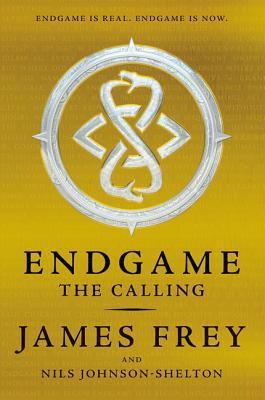
REVIEW: Endgame: The Calling - James Frey and Nils Johnson-Shelton

*COURTESY OF NETGALLEY*

I’ll deal with the controversy first; get it out of the way, and then deal with the actual book. My Twitter feed was inundated with Endgame links (which appeared to be a treasure hunt) and the promotion was crazy. In order to understand what the ballyhoo was all about (as I tend to do when wary of hype surrounding anything), I googled extensively and came across the phenomenon that was James Frey. And his Full Fathom Five. And other book packaging companies. And the faux-memoir A Million Little Pieces. I was also surprised to discover that he was one half of Pittacus Lore of The Loren Legacies fame. But more than that, I guess I was shocked (and I admit, felt a little betrayed) when I realized how much the book industry is considered a business.

I am not that person who thinks that the end justifies the means. But I am also not that person who is incapable of separating the creator from that which (s)he has created. (If I didn’t, I would not have tried The Host by Stephanie Meyer and The Mediator by Meg Cabot; both of which are reasons why I am proud of myself). Once a book has been born, it’s got a life of its own – it lives simply because it has to – needs to. The creator no longer owns it – that’s my stance anyways (that’s what Walt Whitman said too). So I made up my mind to judge this book for itself and not who and how it was written – despite my opinions on either of them.   

So, yes, we’re now getting to the book. Once I finished it and scrolled through the Goodreads reviews, I realized I wasn’t the only one who felt like the concept was a la Hunger Games deja-vu. And for good reason. The blurb sure felt like one, and ultimately that is the whole plot. Twelve tribes send in their Players (who have to satisfy the age eligibility criteria) from among which, one will emerge the winner after the bloodbath. The prize is different though. Instead of nice food and a warm hearth, you get to survive the apocalypse.

I can’t remember the last time it took me this long (a week, to be exact) to finish a book. Hell, I finished the 800-something pages of HP Book 5 within 36 hours. It wasn’t that the pace was slow, there were too many characters who were fighting for page-space. Too many to keep track of. I had over-ambitious plans for this book – I’d even registered for Endgame, because I like meself a good puzzle, but it was a chore reading this one. For each sitting, there was the initial starting trouble; there always seemed to be something better to do than read the book. I thought I was going to have to mark it a DNF. It’s not very professional of me to admit this, but I can’t guess at the reason why – too many characters and the personal drama that ensued – maybe, yes – but that’s not good enough a reason. The narration written in the present tense (especially An’s distinctive POV) had the appropriate dramatic flair to it, which makes me wish for the movie version of it. I also unconsciously worked out some “clues” before the Players did and the victorious feeling that followed the epiphany is pretty nice. But I’m too high on the holiday cake and wine, and I can’t find it in me to figure the rest out, I just wanted to move on as quickly as possible. The book failed in its primary mission as far as I am concerned.
So I did what I do best. I took out my critic eyeglass and looked through it, treating The Calling as a book and not some treasure map. I should now mention that I didn’t like any of the characters, so there was no point in asking who I rooted for. And maybe that was intentional, I mean hello, they had been trained to kill since they were born. So a more valid question would be who I hated the least. The one character that I sympathised with dies in the end, and another one that I thought kicked some butt also kicked the bucket. The mortality rate is worrying, but only predictably so. I also detested the Christopher-Sarah-Jago dramaction going on. It was pretty hard to not judge them.
Then the author inaccuracies turned up. I have lived in Dubai for close to two decades and I didn’t realize that sandstorms were this popular here. I mean, wherever did Mission Impossible: Ghost Protocol get that idea too, eh? Dubai also doesn't allow boyfriends and girlfriends to share a hotel room, someone please tell that to Kala and Christopher. Also, the Harappan, Shari Chopra (who is seventeen years old), already has a kid named Alice (which sounds pretty Christian to me) with her husband Jamal (which is a popular Muslim name). The circumstances that could have led to such a family are remote – especially if she was trained in the family – which is obviously upper caste –  who would have married her off only after she was at least 18, and that too, to another Hindu boy. She couldn’t have eloped; not if she was a Player.

But let me put this right. This is a good read. I have a feeling that maybe it was supposed to be as good and un-put-downable as a Dan Brown thriller and for reasons inexpressible, it didn’t make that cut, but comes close enough. There has evidently been a lot of research done and sleep sacrificed and I acknowledge that. And the talent required to handle these many characters simultaneously, giving them individual voices, is laudable.


VERDICT: 3 STARS

Tuesday, December 23, 2014

Confessions of a K-Dramaholic

Hold your judgements, people. Before you snort in disgust at my apparent two-facedness (since I seemingly can’t stand romantic literature but you’re still seeing this post), allow me to explain.

You might have noticed the disturbing gap between my last post and this one when I promised you in November that my winter break was going to up this space’s tempo. That didn’t happen, because, er, sometimes even after you’ve finished off a TV series marathon, you can’t get closure, so you fast forward through it again – probably by using hostages to explain to your parental authorities that you’re merely stuck in front of your laptop because your hostage made you watch it with her. Definitely not the other way round. Naturally, my TBR pile got bigger (because, I can’t resist buying books with BUY 2 GET 1 FREE stickers) and my e-ARCs are pushing themselves to their expiry date. My roommates were disgusted by what they saw; my parents let their jaws drop when they caught me making soppy eyes at the screen when the actors touched lips for a long time with music playing in the background (HOW IS THAT CALLED KISSING I WANT TO KNOW) and I decided I needed to explain WHY. (To myself, first and foremost.) And I also, uh, needed a post ASAP.

CONS:

  • Okay. So the dialogues are cheesy. Extremely. But I am fully prepared to accept that it might be because of the translation problems. In order to fully understand this issue, I thought of translating popular Hindi and Malayalam songs (which are pure poetry) into English in my head and that exercise killed me. Because poetry in Malayalam = Cheesiness in English. Same problems, maybe? But there all lots of little phrases of wisdom peppered throughout and some one-liners that made me roll around laughing, clutching my belly.
  • And the drama is extravagantly so. Yes, that’s there. I felt like pulling out my hair every time a new iceberg kept cropping up to drive my ship apart. The money-driven mother, the obsessed fiancé, the random admirer, the jealousy and self-sacrifice involved in all of the above, was just too much on my nerves. I know it’s going to be a happy ending, so can you get there already?

PROS:


  • ALL THE GUYS
(Insert a heartbreakingly huge sigh here) I mean. Just look at them. Even the supporting actors. And the villains. They do look … not as manly as I would have liked, but they’re still so. I mean. Uh. Um.
WHERE DO YOU GUYS COME FROM?
HOW DARE YOU SHOW YOUR PRETTY FACE HERE?

  • The Badass Heroines
I don’t care if they use stunt-doubles. I really don’t. It’s the character they portray that matters. All of Geum Jan Di’s roundhouse kicks made my eyes bulge out in envy. Her sarcasm and yelling. Who knew walking, talking death threats could be so cute too?

Cha Eun Sang’s altruistic talents. Her penchant for issuing empty threats.

Park Gae In: Weirdness. Obtuseness. Fierce Friend Protector. And her enviable ability to eat anything, anywhere, anytime.

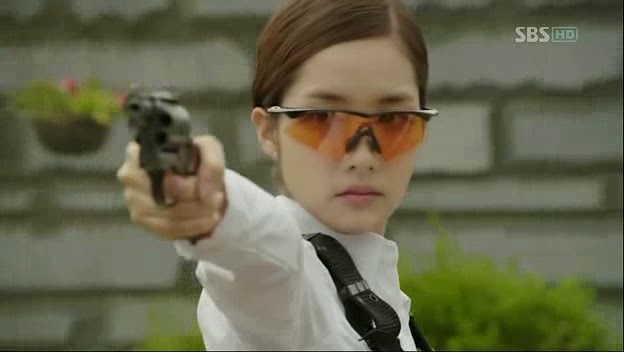
Kim Na Na’s jealousy. Her taking responsibility for her own feelings. Her survival skills, both emotionally and otherwise. And man, can she shoot an outlaw.

  • THE MUSIC
The hero and the heroine have a theme song to themselves. The anti-hero or the third corner of the love triangle has one for every time he looks at the girl. One for the girl lost in thought. One for every time the male corners of the triangle fight. One when something ominous is going to happen. And they are all so good, man.
  • The Direction and The Camera
Just like how the writing style of a book determines whether or not I like the plot, the director’s abilities clinches it for me. The very strategically inserted flashbacks (yes, sometimes, they do go overboard with it). The nightmares whenever the hero is stuck at a crossroads. How they include the weather elements like the sun, snow and wind for the emotional scenes. The STUNTS, man. And I simply can’t resist making wallpapers out of my screenshots every time.
  • The Bloopers
Okay. Yes, I’m cheating with this absolutely unnecessary plus point. It doesn’t hurt at all to watch them, though.

Lee Min Ho weird dancing
I just needed to use this GIF somewhere

Saturday, December 13, 2014

When The Authors Get It Wrong

That is one damn scary thought. I really don’t have any statistical proof when I say this; just making a naïve observation, but I think that the majority of bookworms lead extraordinarily ordinary lives. As in not terminally ill, not a psychopath, not an assassin, have never been raped, don’t have Asperger’s, don’t have LGBT related acceptance issues, are not Holocaust victims, don’t have dead parents, lovers, or best friends. And that one line just described the themes explored in about the majority of realistic YA novels.

So why are they written? If I had cancer (God forbid), I really don’t think I would have like to read The Fault In Our Stars ­– would you? Would you like to read about how a girl in remission meets her one true love at a support group who in the end dies? Or My Sister’s Keeper where Kate’s cancer felt like some deux ex machina tool to find a boyfriend who also dies? I’d most probably read some chick-lit day in and out and celebrate Meg Ryan and Katherine Heigl movies and lots of K-drama. And maybe some of those inspirational books people in my life feel obligated to buy me.

So these stories are written for the sake of the ones with extraordinarily ordinary lives. So that we can empathize – like Atticus advises Scott to climb into someone’s skin and walk around it if she wanted to understand a person. All this bigotry and hate in this world bubbles up from the fear of the unknown – maybe gays are mistakes of God and they are just a blemish on this world, right? Thus marks the entry of anti-LGBT activists.

Speaking for myself, I would have to say that books made me a better person. It is with some shame that I admit this, but I’ve been brought up in a society that is extremely prejudiced. Where mentally-challenged kids are openly referred to as “retards” – I haven’t heard a more polite term in my mother-tongue. Where gays are freak shows. Where cancer patients are regarded as sorry sights. (Please don’t judge us – we’re growing).

So that now we’ve answered the question of Why These Books, let’s move on to the title of this post. How thorough is your book? It’s shit-scary even contemplating about writing a book that features these issues – I mean, damn it, how do you do justice to your character? Fine, so you have a way with words and you feel like there’s a story waiting to be told. But your character’s voice. His agony. Her strength. How do you put it into words if you’ve never been through it, personally?

Research. Lots of it. Interviews with people like your character, their loved ones, doctors, psychologists, reading memoirs, war-accounts – the whole shebang. Katherine Stockett wrote about her fears of not being able to write in the voice of a wronged black maid in the South in the Author’s Note in her The Help. And I totally understand her. I don’t know much the book came under fire for political incorrectness but I do know that it affected me in some way. And GOD – Jodi Picoult. See http://www.jodipicoult.com/faqs.html for an idea of the research involved in her books. Just reading it made me tired and awed at these superheroes. And maybe you should also read Patricia McCormick’s Sold and Never Fall Down and Cut to expand your list of brave authors.

But what if they are still wrong? Murphy’s Law, being what it is, is bound to turn up author inaccuracies. The idea of this post came when I was scrolling through the reviews on GR after I had finished reading Laurie Halse Anderson’s Wintergirls. While I was reading the book, the thought that kept popping was why the hell she was known as the Author of Speak when Wintergirls was this good. If you aren’t a cutter (like me), don’t have an eating disorder (like me), don’t know what it feels like to hear that your best friend committed suicide (like me), then like me, you will feel short of breath at the magic Anderson wields with mere words. I mean. That Book. Is. Just. And I provided those conditional clauses in my judgement because I really don’t know how you would feel about it if you were Lia. It’s not a book you read curled up with a coffee in hand; it’s a book you clutch to firmly trying shit-hard not to fucking cry, and pray for girls like Lia and Cassie. So once I had recommended my GR friends how they should really read it, I happened to see some other reviews. That left me confused. So what was LHA doing? Merely showing off her writing skills and shamming us?


I don’t know the answer to that question. I don’t know if Jacob in Jodi Picoult’s House Rules is who a kid with Asperger’s actually is. I don’t know if Gabe in Beautiful Music For Ugly Children represents the trapped individual living in a body of the opposite sex. I don’t know if closure is as elusive as it was for Oskar Schell in Extremely Loud and Incredibly Close. But I do know that these books needed to be written because else we would continue thinking that we were “normal” or "okay" and they weren’t. 
Add your graffiti here before you leave; this wall needs all the colour it can get. And check back, I always reply as promptly as the wifi allows me to. ;)