Showing posts with label POCs. Show all posts

Tuesday, February 21, 2017

REVIEW: Small Great Things - Jodi Picoult

People ask me how I pick books to read – do I look at the Bestsellers list? Do I look at Goodreads recommendations? Do I look at what other book bloggers are spazzing over? I do all of the above, but more often than not, I refer to a short list of writers whose releases provide enough and more literary satisfaction for me and ensure I’m well fed. Picoult leads this list.

Her books compulsorily have three ingredients: a plot that mandates a tissue box by your side, a writing style that gives you the benefit of walking in the shoes of different characters to look around and judge for yourself but most importantly, characters that can’t be classified as good or evil – in the end, no one is blameless. Everyone is human.

Picoult gets in my head and confuses with my ideologies. This is also why she’s one of the writers I hate the most. Her books always tackle subjects that are to be debated over tea, (possibly) in raised voices at book clubs, and keep you up at night wondering if the characters made the wisest choices and had you been in their place, would you have done it any differently. Needless to say, when I heard she had a book coming out about racism in contemporary society, I confidently dropped big bucks without even pausing to look at what everyone had to say about it.

I hope the panda was a nice touch
Confession #1: I was in a reading slump. You can verify that by merely looking at the date of publication of my previous post on this blog. Maybe I still am in a reading slump – I’m unravelling a little at the edges. But I read this book from start to finish and I consider that an achievement.
Confession #2: I am not the best person to judge this book, and I won’t pretend to be one either. I have never stepped foot in the US, I am Indian and usually navigate in predominantly Indian circles. But, in case this is news for you, racism is not exclusive to multi-ethnic societies. You’d be surprised at how widespread, silent and invisible racial discrimination actually is and I am no stranger to it.  But, as usual, I digress.


I loved her choice of PoVs: the victim, the lawyer and the white supremacist – expected, but still commendable – because warping reality into what might make logic for a douchebag requires genius and intensive research. I dreaded reading Turd’s Turk’s PoV chapters because it felt like sliding underneath the slimy skin of a monster. This isn’t my first time: Amy in Gone Girl, and Alfred in Salt to the Sea helped me mentally steel myself against Turk’s viciousness and feel pity for the likes of him. You can never justify their actions, but you can understand them.

Surprisingly, it wasn’t Ruth or Kennedy or Turk that intrigued me. It was Adisa. Adisa is such a solid character – so very real – in her blunt stubbornness, her own racist inclinations – a lot of spice with a dash of sugar. I wish Picoult wrote Book #0.5 from Adisa’s eyes – I want to know if she really sees the world in black and white or in Technicolor but pretends otherwise. I was especially impressed by how she weaved the past and the present in her narrative, not jarring against each other, but providing the other a context for us to understand better.

This book really messed with my head – I forged through the constant volley of questions thrown at me, taking breaks in between (you can’t read this at a stretch, nope) to mull over the answers and maybe pretend like I didn’t know them. And as I drew near the end, I began to dread the signature Picoult twist (usually someone you least expect and care about the most drops dead) and I wasn’t disappointed.

Another thing I love about Picoult is the copious amount of research she dedicates into her work. I despise inaccuracies or misrepresentation, especially when you’re dealing with sensitive matter, and this book wouldn’t have been easy for her to write. A white woman trying to voice the discriminated? It would have been intimidating, considering that she knows what she’s setting herself up against. But she did it, anyways.


Most of all, I loved the title. Small Great Things, is a reference to a Martin Luther King quote, like she explains in her Author’s Note. The plot is essentially a quest for a greater victory, but the actual greatness of the novel was in the small victories. When the father held his faceless newborn. When Ruth touched the baby. When Kennedy understood what racism actually means. Small great things like that.

VERDICT: Just do yourself a favour and read it please.

P.S. Miss Picoult, if you're reading this, thank you for this book. Also a huge thank you for the epilogue which restored my faith in humanity. 

Saturday, May 23, 2015

REVIEW: The Wrath and The Dawn - Renee Ahdieh

My cheeks are pink and raw. My hand stings from all the slapping my cheeks endured. I catch sight of my roommates as they exchange worried glances at my increased tendencies to inflict harm upon self while reading this book.

I have not learnt my lesson and never will. A book’s ranking in my TBR list is still highly influenced by the book’s performance evaluated using standards defined by the mass. Which is why I picked up this book when I found space to breathe in between my exams, since everyone can’t stop flailing about it. And once I started reading it, promptly started faulting with it.
I avoid hate-reading as much as I can. But if everyone is swooning around the book, and I’m not, I stick around till the very end to see if the book redeems itself and if magically I’ll love the book too.

That didn’t happen here.

WARNING: Proceed with caution. I won’t spoil the potential reader; but once I start, it is difficult to contain my vehemence and fury at being scammed. Also, this is a 1000+ words review, sorry.

I am a sucker for the writing style. Disappoint me and the poor book will have incurred my wrath. I started out by liking the way the story was writing itself. About a chapter in, I quickly revised my assessment. The writing is annoyingly repetitive. The reader is kept entertained with regular weather reports and the menu cards for every meal. I go weak in the knees for books that employ a cinematic approach to the story which was why I laboured under the delusion I will like this one as well, since it has a similar objective but tragically fails at fulfilling it. The book didn’t have a cinematic writing mood – it was over-the-top dramatic and too pretentious for my taste. I felt like I was watching a fucking Bollywood movie; one in which everything happens in slow-motion, moral dilemmas are stretched on for hours, doors (both physical and emotional) are slammed when the central character wants a theatrical exit and lovers quarrel. In addition, no one is allowed to question the soundness of the plot, you just go along with the ebb and tide of it.


I’m sorry, but I just can’t do that.

Humour me and engage in a little method-acting. Imagine your inseparable friend of many years is the last victim after so many girls have been killed with no explanation by a guy you know nothing about. After wading through denial and recurring nightmares, the justifiable anger compels you to take revenge.

You decide to destroy him.

What do you do? Probably start with collecting as much information as possible about your mark. If your mark is the Caliph of a country, you will have to extend your research to the people he is around with. Draft plans A, B and C. Decide to get close to him and then hit him at his weakest.

You want to hear Shahrzad’s A Thousand and One Nights - inspired plan? Volunteer herself as the next bride to be killed, wait for the Caliph to come to her at night, charm him with her wit and storytelling prowess and then if he lets her live, then research him and when the opportunity presents itself, kill him.

Notice any flaws?

This book would not have happened if Khalid hadn’t come to meet her on the night of her wedding, because she didn’t have Plan B. And somehow the notion that cliff-hangers can postpone a scheduled execution is a bit ludicrous. But then, miracle of miracles, the Caliph decides she’s the one to break the cycle. (I distinctly remember muffling a scream with my pillow at that point.) Then she gets a tour of the palace, courtesy of a snarky handmaiden, and she gets shocked at the security and wonders at the strength of her “plan”.

No seriously, Shazi, what did you expect to see? The King of kings living alone in a gilded palace, waiting to present his head to you on a platter?

That’s not all she’s shocked by.

He’s the second-best swordsman in all of Khorasan? Well, damn, I didn’t cover that in my background check of him. Oh wait. I didn’t do one.”

Shahrzad is infuriating. She pretends to want archery tuitions and then promptly shoots an arrow like a pro. The next second she starts cursing herself for her “stupidity” and I’m left agape. When a particularly life-threatening episode happened, she rants against the Caliph and throws quite a tantrum. I mean, she’s literally outstaying her welcome and her life was a gift and she acted like it was a breach of trust that warranted Khalid the Where-Were-You-When-I-Was Dying interrogation. He’s still your best friend’s killer, isn’t he?


Guurl, you wanna know how to kill someone? Lemme show you how that's done.

Which brings me to my next point. We are supposed to love Shiva, the best friend mentioned above – no questions asked. No interspersed flashbacks. No nightmares. Just a lot of “Shiva, I will kill this man for you” and “Shiva, what do I do” and “Shiva, give me strength to withstand this inexplicable attraction to your killer” and other timed Shiva-tagged self-reminders that she should hate Khalid. She keeps obsessing about her “plan” for revenge half the time, and the other half is spent asking herself not to end up kissing the murderer. No actual murder attempts take place.

That’s just it. How do you fall in love with your best friend’s murderer? I’d expected answers to this question, not be left more flabbergasted than ever. This is where I admire Marie Lu with her Legend series. There, a similar quandary of a reverse nature was engineered. Boy and Girl fall in love. Boy later finds out that Girl (indirectly) was responsible for his mother’s death. He still loves her, but both realize they can’t be together. Now, that was a book.

Well, obviously Shazi is battling with the Stockholm Syndrome – a condition worsened by the fact that the Beast is not a beast (physically or otherwise) and handsome as hell to boot. With a tragic past that is often hinted at. With so many secrets. Our Shazi, pleads him to open his door so that she may see what it is that makes him a monster. “I know nothing because you fight me every step of the way”, she says. Again, dead best friend issues are kept on hold. Not even that matters when you realize all killers aren’t the heartless monsters they are generally portrayed as – that have a story too.


And then the "kiss that changes everything" happens.

Khalid is no better off – being the poor, tortured soul that he is. The book has a third person narration and Khalid gets a solitary paragraph written from his perspective, just in time to venerate “the plague of a girl” that is destroying him. I also hate him for deciding to come see Shazi that night and never before for another bride. Had he done this earlier, who knows, he may have fallen in love with another girl and the murders could have stopped way back.

The one thing that nagged at me was the frequency with which Shahrzad’s skills at seduction came into use. I personally despise characters that use sex as a weapon to wound and open up the enemy – I find that weak and underhanded. Not to mention how that strategy would fail would for us poor unglamorous mortals. Although she immediately regrets it afterwards, the fact that she did it was the last straw for me.


The plot of this book is a love story. How Inexplicable Attraction To A Murderer With A Tragic Past can change everything. I don’t mind love being a deux ex machina element in the story – I do believe love has its own magic – but this was a bit too much.
Oh and wait, did I mention a tragic love triangle involved for the sake of?

I would be doing an injustice if I didn’t commend the research that went into the world building, especially the Persian/Urdu words that cropped up like a pleasant surprise. Khorasan is a Persian land and I’ve always had a special fascination for that place ever since I became a fan of Arabian tales. I also do like the other characters – Despina’s sassiness, Jalal’s protectiveness, and another character who I started to really like and had so much scope for development and then gets killed. Three cheers to me.

I am glad though that my resolution to keep calm and carry on reading till the end of the book paid off marginally. I feel like the main plot of the series is just beginning and I like that plot. Not this soppy, messy love story that I had to endure. Usually, in the kind of series that I binge-read, people run for their lives and they fall in love sometime in between. In this one though, they fall in love first and then run for their lives.

VERDICT: 2 stars.


Friday, April 3, 2015

ARC REVIEW: The Merit Birds - Kelley Powell


*COURTESY OF PUBLISHER VIA NETGALLEY*

 Eighteen-year-old Cam Scott is angry. He's angry about his absent dad, he's angry about being angry, and he's angry that he has had to give up his Ottawa basketball team to follow his mom to her new job in Vientiane, Laos. However, Cam's anger begins to melt under the Southeast Asian sun as he finds friendship with his neighbour, Somchai, and gradually falls in love with Nok, who teaches him about building merit, or karma, by doing good deeds, such as purchasing caged "merit birds." Tragedy strikes and Cam finds himself falsely accused of a crime. His freedom depends on a person he's never met. A person who knows that the only way to restore his merit is to confess. "The Merit Birds" blends action and suspense and humour in a far-off land where things seem so different, yet deep down are so much the same.

This is my fourth attempt at an introductory paragraph for this post. I am literally clueless about where to start. Should I begin with how impressed I was with the writing? How Powell was able to capture that which makes us all human and encase it with words, plop them down in circumstances we possibly couldn’t understand, slap them with some names and introduce them to us as her characters? How, towards the end, this book became something larger, something much beyond what I expected?

(I can hear the fridge humming as I sit and stare at the blinking cursor that seems to mock at the sudden deficiency of my virtual loquacity. No, seriously, what has happened to me? There is every possibility that it’s because it’s been inexcusably long since I last wrote anything resembling a book review. That said, I’ll still shamelessly throw in my regular excuse: college life is screwing with me.)

I have read books set in places, casting people geographically, ethnically, and culturally contrasting to the author’s. While most of them treaded upon that road which was less travelled by, they did so with a sense of caution. They knew how they were susceptible to errata, and how they could multiply in terms of consequence, however meticulous their data collection might have been. And so the tragedy remained that the audience could never fully get under the layers of the characters. Books starring POC characters became the sort of thing that you had on GR shelves labelled POC and as a bullet point in Diversity In Books campaigns. This book is that rare book that goes the whole way FLAWLESSLY. I won’t pretend I know the mechanics of how Laos and its people run (I don’t) – but I could immediately relate to the characters, being Asian myself.  How Seng was fascinated by America – land of the rich, home of Hollywood. Or the picture of it in his mind. How the locals immediately resorted to head-shaking and frowning when they see a boy and a girl together. How Lao guys don’t think too much before throwing an arm around another guy’s neck. How two members of a family don’t see shame in sharing a bed together. How an individual puts his family before himself. How they can’t understand why the white-skinned people would dry-wipe their asses after having a crap. All little things, especially in the way these facts are thrown in the readers’ faces like a careless inconsequential detail. But they went a long way in defining those tricky edges of the characters.
This book teems with life. There is that boy who’s dealing with culture shock – starting with the fact that he has to shit into a hole in the ground. Like he already doesn’t have enough to deal with – anger management issues, mom issues, dad issues and homesickness. There is that girl that survives alone through all the shit life throws at her and becomes guarded to the point that she shies away from the possibility of love. There is her older brother who feels the weight of the title as the head of the family after being abandoned repeatedly – first by his parents, then his older sister. A weight further amplified by the sense of his failure in the same. Khamdeng with his loyalty. Somchai with his capacity to love. Sai with his wisdom and patience. Julia with all her sins. All merit birds. The victory of this book is that it tries to get under all the layers of most of the characters – including the ones skulking on the periphery of the main plot.

At first, I didn’t get why only Cam got a first-person. I mean, this story is as much as Seng’s and Nok’s as his, right? But then Somchai rebukes Cam for thinking only about himself, contrary to the Lao and I realized that might be it. That’s when I got my hint this story was on its way to evolving into something more.

Yes, by that I’m implying that I judged this book. It had every promise of turning into a love story spanning across borders of all sorts – and then suddenly it was not just that. In fact, somewhere around the middle I desperately wished it had stopped at a love story. At first, the plot steadily climbed the plot hill at a measured pace and then things crashed and burned. Spontaneously combusted. And I was the sole survivor – left to collect the pieces and make sense of it. That was the thing I disliked the most about this book – the incredulous rapidity with which a series of unfortunate events unfolded. The middle was the lowest point of the book – the peak of the plot hill felt staged.

Despite that and other minor failings, this book is a must read for all those who scream blood for diversity in books. This is a book that you should read at least twice – first to read the lines, second to read between them. 

VERDICT: 4 STARS

Tuesday, January 6, 2015

ARC REVIEW: Rogue Wave - Jennifer Donnelly

*COURTESY OF PUBLISHER THROUGH NETGALLEY*

 Just when you think every possible idea for the next YA fandom has already been abused (Dystopian? Unashamedly so), Jennifer Donnelly enters with her Waterfire Saga. You might want to read what I thought about Deep Blue before you continue reading what I thought about Book 2 ‘cause then I can pass on the raving episode about unconventional mermaids, POC MCs, the matriarchal society (which if my memory serves right I didn’t talk about, but is actually a huge thing here), and the awesomeness that’s Merrovingia, and focus on the finer points of Book 2.
BEHOLD a fine example of cover art


OK, so it’s no big secret that I have memory problems which is why I wait till the series finale has been released to start reading the series. Sometimes, though, I can’t wait for three years so I start anyways. Therefore, unsurprisingly, I managed to forget the finer details of Book 1 but thankfully the book reminded me here and there. But the lack of subtlety and the frequency with which those recap facts appeared pissed me off. Some were even redundant enough that a wannabe initiate into Merrovingia could just pick up Rogue Wave and still know what’s happening.

Another thing that annoyed me was how much the progression of the plot depended on someone else’s sum of experiences. The truth about who the invaders are, what they are after, and how the merls can get their hands on them before the bad guys do, are all uncovered topic-wise as a result of  someone’s storytelling, rather than something that involves a lot more adrenaline and tension.

Then there is the plot. Yes, it’s turned out to be one of those “find the Deathly Hallows to save the world” stories, but even that somehow has its own indigenous flavour – what with sea-witches, dragons, shipwrecks, hot outlaws with tails, badass tribes, trawlers, and the like. I started reading at around eleven in the night and it was with a heavy heart and equally heavy eyelids that I decided to turn in for the night at around 3am. Yeah, because the plot? It’s good. Like “I-need-to-know-what-happens-next-right-now” good.

So, considering this solely as a plot-intensive novel, designed to be a really good read, this book is at least four stars. But, otherwise, taking the writing into account – meh. I am a big fan of puns and punsters (since yours truly couldn’t pun to save her life). And this book was a real treat in that respect. (Although SILT! some were just a bit too much). Then some phrases that have been considered cliché since long ago showed up here and there, which I suspect were intended to be under the Goodreads quotations tab. And I totally sympathize with the author for the quandary she was in – whether to concentrate on the finer aspects of the world building and flaunt her writing skills (for a clue as to how awesome they are, you just need to read all the songspells) and compromise on the plot or vice-versa so that we don’t end up with a massive tome on our bookshelf.  I really did wish that the other chosen merls beside Seraphina and Neela had a chance in the spotlight in this instalment though. That regrettably didn’t happen.

In fact, what happened was jaw dropping. What I thought was developing to be yet another love triangle morphed into something else entirely. I predict some hormone-driven drama in Book 3, and I decided I’m ok with that. Also, the cliff-hanger was a decent one; it didn’t make me want to storm into JD’s house and demand to know what happens next at gunpoint; just enough to make me badly want to start the next book.


VERDICT: 3 stars

Tuesday, September 16, 2014

ARC Review: Ghosting - Edith Pattou

*COURTESY OF NETGALLEY*

(Blurb from Goodreads) On a hot summer night in a Midwestern town, a high school teenage prank goes horrifically awry. Alcohol, guns, and a dare. Within minutes, as events collide, innocents becomes victims—with tragic outcomes altering lives forever, a grisly and unfortunate scenario all too familiar from current real-life headlines. But victims can also become survivors, and as we come to know each character through his/her own distinctive voice and their interactions with one another, we see how, despite pain and guilt, they can reach out to one another, find a new equilibrium, and survive.

Told through multiple points of view in naturalistic free verse and stream of consciousness, this is an unforgettable, haunting tale.


From page one, you get the idea that you are not in for an ordinary narrative style. At first I thought it was some formatting blunder; but I read on (sheesh I’m so stupid) and I thought, “Whoa, this is some blessed blunder, the plot makes more sense this way”, but I’m not so stupid – this thought was immediately followed by the realization that it was intended this way.

You know life? Like how it’s happening for more than one person, and for that person (s)he is its protagonist? Ghosting applies that into its narration, everyone gets a chance to tell a part of the story as they see it; everyone including the doomed kids, the kid who doomed other kids, and the police chief who has the highlight of his career. From POV 1 you think this guy is the bad guy, then his POV starts and you think okay maybe he’s not so bad, and then another POV starts and you scratch your head.

But that’s not all. The narrative isn’t prose. It’s not very poetic (which if it had been would have made me run around hugging this book), but it’s structured like one epic poem. It feels like how Virginia Woolf experimented with The Waves (although that was poetry which was NOT structured into a poem, which was a DNF for me; the plot moved so so slow, glad you asked). And everyone takes on a different voice when it’s their turn – Chloe with POVetry titles, Felix with his weed supressed ADHD who doesn’t even bother with breaking down the prose, Faith with her short and sweet sentences, and such. You become fond all these kids.

The plot isn’t OUTSTANDINGLY outstanding or something, but the narration and its characters make it into something that you want to finish within one sitting.

VERDICT: 3.5 stars

Friday, August 1, 2014

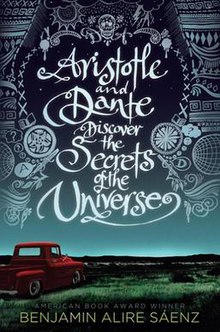
REVIEW: Aristotle and Dante Discover the Secrets of the Universe - Benjamin Alire Sáenz

(Blurb from Goodreads) 
A lyrical novel about family and friendship from critically acclaimed author Benjamin Alire Sáenz.

Aristotle is an angry teen with a brother in prison. Dante is a know-it-all who has an unusual way of looking at the world. When the two meet at the swimming pool, they seem to have nothing in common. But as the loners start spending time together, they discover that they share a special friendship—the kind that changes lives and lasts a lifetime. And it is through this friendship that Ari and Dante will learn the most important truths about themselves and the kind of people they want to be.


Every once in a while, there is the sort of book you pick up - one or two of your Goodreads friends might have five - starred it - and you might not even have heard about it before it appeared in your Goodreads feed.

This was that sort of book.

It isn't a book that comes demanding glorifying reviews. It isn't a book whose SP is "This book will change your life". It isn't a book in which a character's gay-ness is a Major Plot Point.

This book is exactly what the title says. Two boys with funny names, and an unclear sense of their identity, in pursuit of the secrets of the universe.

Profound, huh?

There isn't a straightforward honest to god PLOT. There are no evil high school cheerleaders, no alcoholic parents, no crimes in which the character is a suspect, no sudden baffling powers, and no monsters. Except for the ones inside us.

This review is turning into something that's neither here nor there.

The characters become people you've known for a while now. Ari with his anger. Dante with his wisdom. Ari and Dante with all their guilty pleasures. Ari's dad with all the secrets. Ari's mom with all the hurt. Dante's parents with all their capacity to love.

Benjamin Alire Sáenz has a beautiful way of writing. It hints at his power of language but also speaks of his deliberate usage of simple language - it was Ari talking. When a fifteen year old questions the universe, he doesn't use big words. Like Ari says, "To be careful with people and with words was a rare and beautiful thing."

I had to travel 24 hours on the bus for one week. So it was roughly a book per day. That was how I picked up the book. Out of desperation. But I felt a constant smile on my face. Sad smile. Fond smile. Happy smile. "These boys" smile.

VERDICT - Five stars. 

Saturday, May 3, 2014

Saving The Dreams Of Rainbow Coloured Kids

In an earlier post I confessed something about POCs and MCs in books. This is what I said, verbatim: “No, I don’t care that there is a severe lack of POCs as MCs.”

I need to explain.

NovelSounds posted on the vacuum in the book industry we have because there is a very limited variety of books wherein a POC character is the MC. I read this post among the recent slew of posts I read as part of the #WeNeedDiverseBooks campaign.
It was when I commented on that post that things fell together about how exactly I feel on this subject.

Where I live, the number of people who read as (ir)regularly as me can be counted on one hand. The concept of Teen/YA literature for them is limited to even fewer number of books written by Indian authors in English about family - forbidden romances against the backdrop of an engineering/medical college. For someone who cannot stand such repetitive stories, such as yours truly, I turned to American/British/Australian publishers.

As a result of my current bookshelf and movie favourites, I know the Miranda rights by heart; I know what constitutes the American breakfast, I can identify bridges and train stations in London, I have an Indian accent but my vocabulary consists of both British English and American words (even though I’m supposed to technically be a “Borrowed English” speaker), I know what to do in the event of a zombie apocalypse, I can recognize an Australian accent; and I don’t find gorgeous enough guys here, thanks to Spanish guys like Jesse from The Mediator series and gay guys like Neal Caffrey (ugh, Matt Bomer you twit). I don’t even appreciate the glamour of the “moochi” (moustache) Indian guys have here.

Hush, don’t tell. Not that I’m breaking any hearts anyway.

The worst part: When I replace myself as Katniss in my dreams, I’m white. Not the Indian version of Katniss the reasonable/indignant/conscious part of my brain would say I’m supposed to be.

There was a reason why I said I didn’t care much about the lack of POC characters. I know, when I’m picking up a book, it’s going to take place somewhere in Seattle, or London, or other places I’ve never been to. So I know I can’t expect people to eat chapattis for dinner, or have their parents fix their life partners for them. I know it isn’t fair to ask J. K. Rowling to make Ron black and Hermione Hispanic, in the name of diversity when they’re people she dreamt up. You can’t give birth to characters whose ethnicity you’re not too familiar with. What if you inadvertently do them wrong?

Then there are the POC writers themselves. Some of them don’t want to cast POC MCs because it would make them look like narrow-minded people. So the only way we can have POC MCs if they come alive in the writers’ heads of their own need to save the world.   I personally don’t want to read books for which writers sat and scribbled bios of their characters THEY WANTED TO HAVE instead of characters THEY NEEDED TO HAVE. As in “I want my heroine to be named so-so, she should have freckles, and green eyes, and short red hair”, vis-à-vis - “this boy came in my dream last night – I wanted to know his story.” Psychology can tell us that when this happens it’s usually a character of our own ethnicity. How could I blame white writers for casting white characters? Should I blame a black writer for not casting a Japanese protagonist? Hence, the second sentence of this post.

Look at me. I’m telling people how a character should evolve when I’ve written – hang on, let me count – ZERO books.

*pauses a moment to strangle yours truly*

That said, I don’t want my kid cousins to think America is full of only beautiful white girls. I don’t want my sister to think black boys can never be a Marvel superhero, only a sidekick. I don’t want myself to have crushes on only the white guys with a spare upper lip and brown messed up hair because they look so dang good in tuxes brandishing an FBI badge.

I totally worship Marie Lu for what she did. She did a tumblr on her inspiration for casting Day as a Mongolian kid (not fully, more of a mixture of different races). She also said that since the Legend series took place in a dystopian universe, instead of ethnic segregation, she chose wealth segregation. That’s logical. Therefore, you can find her book filled with characters of so many different ethnicities that it’s beautiful.

Another confession:
I want to write a book someday. I have never been to the US or anywhere else. Do I set my story in Dubai where I grew up? Or India where I’m living now? If I do, I can guarantee that my audience will be limited as well. Most writers have to confront this problem to write in the first place. You probably haven’t have heard of the Shiva trilogy which is a bestselling series here. I have read of teenaged writers who WROTE UNDER PEN-NAMES so that the book has an international market. There are books featuring POC characters but because the international bookish population can’t relate to them, they come and go like a breeze and gather dust on shelves in their home bookstores.

This is what I have to say: We need diverse books. Period. But diverse books can’t thrive ondiversereaders alone. Books need to be read by everyone, diverse or not. It’s not that hard for me to get into the head of a white kid even if I sometimes simply do not get American high school and teen pregnancies. Similarly, it’s not that hard for the “default kind of readerto get into the head of a Filipino kid saving the world.
Readers, Publishers, Writers, save the world. Maybe necessarily in that order.

Add your graffiti here before you leave; this wall needs all the colour it can get. And check back, I always reply as promptly as the wifi allows me to. ;)