Showing posts with label friendship. Show all posts

Wednesday, February 17, 2016

REVIEW (well, sort of): Salt to the Sea - Ruta Sepetys

*COURTESY OF NETGALLEY*

I will never get tired of reading historical fiction. Just when you think you've read enough on WWII from all angles, a book like this comes along and nudges you to look even closer to see things your so-called experienced eyes have missed.


Sepetys says that 'stories of strength through struggle' inspire her work, especially since she's the daughter of a refugee. That's what birthed this book - a successor to her Between Shades of Gray; the book that introduced me to this phenomenon that is her. She wants the world to know and remember what layers of debris resulting from the more flamboyant historical fallout, have hidden underneath and I am very much smitten with her for it.


I admit my shameful ignorance of the Wilhelm Gustloff and thank Sepetys for remedying it. But the truth is that that's not what shocked me the most in this book. What truly horrified me was not the sheer scale of the atrocity, but the less flashy, more relatable kinds of horrors, like - 


Or this - 


But I'm jumping ahead of myself. This book follows the lives of a very interesting motley of refugees. And that of one psychopath-in-training,


Initially, I was mightily creeped out by Alfred's POV accounts and dreaded his chapters. I kept questioning its purpose throughout the book and it was only towards the end that it struck me that even he needs a voice. It's not enough psychopaths like him and Hitler roared all they liked on radios and megaphones - we need to know what really went inside their heads where they were held captives so that we can give them our pity.

But back to Joana and Florian and Emilia and the Shoe Poet and the Orphan Boy and Eva and Ingrid. This is where the book triumphs in the story it is trying to tell. When humanity shines through even when all else is lost. 

So even after I've waxed eloquent about this book, I feel like I'd be lying if I won't admit that I didn't love this book to pieces like I prophesied to myself. I had the same problem with BSoG. The endings of both books left me mildly dissatisfied. This pretty much feels like blasphemy, but I'm missing out on the magic Sepetys did with Out of the Easy. Maybe she felt a pressured need to give justice to the characters in BSoG and SttS and not offend in any way, but I sense a restraint in her writing in this book, unlike in OotE. I don't want to sound pretentious - there's a 150% chance I'm wrong - I was just going out on a limb here.

The last paragraph is a personal opinion; you probably won't find it anywhere else. There's a 150% chance you'll love this book to pieces though.

VERDICT: 4 stars

Tuesday, January 5, 2016

REVIEW: Tell The Wolves I'm Home - Carol Rifka Brunt

This is the second time I’m reading this book. The first time I read it (which I did at lightning speed – like I do for most books – because I don’t have the patience to endure the suspense of the ending), I thought all that the book had going for it was the plot and the characters – which is more than enough for me and which is everything that the blurb advertises.

My most grievous fault.

If you do a basic Google search about this book, you’ll come across numerous posts that have written odes to everything that’s beautiful about this book on the surface. The plot is set in the late 1980s, a time when America was in the grip of homophobia and AIDS was in the headlines all too often. It introduces to us a fourteen-year-old, who finds herself lost after her godfather, confidant, best friend, and uncle, Finn passes away. That’s also when she learns there’s a lot of Finn that she didn’t know about.

That’s not all. There’s Greta – the ace kid in the family – and once upon a time, together they used to be the Elbus girls. Then June learns that her mother – the boring accountant who, together with her accountant husband, orphans their kids during their tax season – has a past that June has trouble wrapping her head around.

And then there’s Toby. And then there’s Toby.

The book explores more issues than I thought it would. Apart from the obvious that you can glean from the blurb, it also delves into the realms of forbidden love and sibling estrangement.  I actually had problems with June. I will not hide my initial disgust when I realized the nature of June’s feelings for her uncle. Nor my annoyance at how flippantly June mentions her newly acquired habit of smoking and occasional drinking. Nor my anger at her decision to accept the invitation to visit an apparent stranger and go places with him.

She does a lot of stupid things. Granted. But that’s also what I liked about the book. It isn’t trying to teach lessons about Stranger Danger or Smoking is Injurious to Health or Falling in Love with Relatives and this is not the book I would recommend as the solution to any of the above. Brunt neither condones nor condemns it – she merely talks about it. That is what struck me – you can’t detect the mature adult author acting as the conscience in the morally-compromised teenage narrator. Because there isn’t. It’s up to you to decide if that’s good or bad.

What I wasn’t prepared for was the imagery. Motifs like wolves, rain, butterflies, Mozart’s Requiem, trains, woods, a beautiful Russian teapot, and negative spaces in paintings show up now and then. I didn’t know that this book was a lot of work and is thus a prime candidate for book club discussions. I didn’t know that you had to read some lines twice and thrice to understand if there was a deeper meaning to what seems on the surface. There are some that you’ll miss if you blink like Finn’s chess set, or the painting Nurse Feeding Sick Man from the Book of Days.


Like I already mentioned, the characters are not whom they seem on the surface. There are layers upon layers on them. You would have peel them off slowly and carefully, to get a look at who they are underneath all of it. And underneath all of it, you'll find that they’re just people, not some characters in a book.

This book is work. But once you get to the end, you'll just remain curled up, hugging it to your chest. 

VERDICT: 5 stars

Monday, October 5, 2015

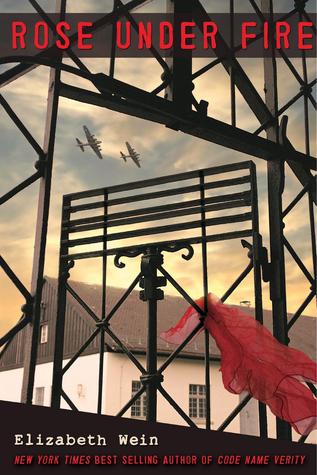
REVIEW: Rose Under Fire - Elizabeth Wein

Elizabeth Wein is a hero. If the act of merely reading her books is sufficient enough to make me feel like I’m choking on air, I can’t even imagine what’s it like for her to conceive her books in her head and bleed life into the pages with her fingers. Code Name Verity damn near killed me. The companion novel Rose Under Fire killed me. Even though CNV is not a reading prerequisite for RUF, it will help many a haplessly clueless reader ease into unfamiliar territory.  

I completed RUF some time back. At that time, I felt I was in an emotionally compromised state to write a coherent review. Deciding to put some time between the reading and the reviewing is one of my more brilliant ideas. If this book is on your TBR pile as well, you’ll know why eventually.

Anyway, being an Ignorant American Schoolgirl gives me an open ticket to ask brazen questions, and I’d already put my foot in my mouth, so I just went on.
“What is a concentration camp, Fliss?”

Given an opportunity, I have never failed to manage to squeeze in a reminder that I love historical fiction. Consequently, I have greatly taken advantage of fiction under the backdrop of the World Wars and the Holocaust, whether in print or on screen. I thought I knew what concentration camps are. I thought I knew what went on in there. I thought I was better than Rosie.

My mistake.

Rose Justice is an ATA pilot – out of America and in England, chasing her love for planes. For her, the horrors happening in Germany and elsewhere was an abstract idea – she knew people were dying and they needed saving. For her, the real tragedy lay in Doodlebug Brides and couples getting married in haste and boys fiddling with unexploded bombs in the hopes they can defuse them. Then again, she’s just eighteen years old crazily in love with flying in the sky and writing poems.

Everywhere I go I meet people who are hunting for husbands, mothers, children, brothers, sisters, cousins, friends, lovers, and they are all gone.
Your friend Rose has evaporated with them. I don’t know what else to tell you Maddie.

Then the horror accounts start. How they start by taking away your name and giving you a number. We hear about fleas who are in league with the SS. About 50,000 women locked inside a prison half a mile wide and a quarter of a mile across with no toilets. We learn of Rabbits. Our lives are changed forever.

When you lost hope, you turned into a schmootzich, one of the mindless beggars who were the bottom-crawlers of that entire scummy camp, or you died.

If you think this book is one of those books that preach nothing but morbidity and mortal moroseness in the name of empathy, you are dead wrong. This is not one of those books. This is that book that inspires awe. Awe at how much life and hope and dreams can thrive even in places that seem beyond despair.

It took me a long time to write ‘The Subtle Briar’, but it was translated into three languages in a day. Every time it got passed on I got another bread ration. Oh God, we needed something to cling to. We were scared.

The technical bits about bombs and planes, the poems and the characters are what sets the book apart from its peers. Many might feel the tech stuff is infodump but I lived for it. The Subtle Briar and Playing Statues are my favourites. Róza, Irina, Karolina, Lisette, Micheline, Elodie are my favourites. Even Anna. And Nick from the Nick stories. You will be rendered unable to label them fictional characters because of the sheer depth Wein has endowed them with, which is an accomplishment considering the number of characters this book is peppered with.

When you’re flying, the changing balance of lift and weight pulls you up and down. But another pair of forces pulls you forward or backwards through air: thrust and drag.
From Kite Flying: four principles of flight (by Rose Justice)

I think what made me love this book is the fact that there are no unnecessary deaths. (And by that, I am in no way claiming that the deaths that do happen were necessary.) I have noticed a disturbingly common authorial tendency to wantonly disregard fictional characters’ lives. Like they think killing off someone we love in our faces and the tears and heartbreak that inevitably follow is the price of loving a book. But Rose Under Fire does not resort to any such cheap tricks even though it could have and I love it all the more for it.


VERDICT: Freaking Five Stars

Tuesday, February 10, 2015

Like Velcro


There was a sound,

Final, resolute, irreparable,

Like a kiss broken in half.

But velcro doesn’t make that sound, does it?

How then did I hear it –

In the promises unmade,

In the hanging up of the phone,

In the silences between words?

Do strips of velcro feel pain,

When they’re peeled apart?

Why then do I hurt

When I see –

The empty REPLY box,

The ghost of her old smile,

The scrapbook that made us?

Her velcro patch has collected

Dust, dust, more dust.

(She always was careless though.)

Dust like –

Secrets,

Hurt,

Tears,

Ache.

(She claims they were souvenirs,

In her quest for happiness.)

I pluck the stubborn,

Remainders from her velcro patch.

(Or try to –

Velcro is as stubborn as the dust.)

Maybe the wind won’t,

Steal our laughter again.

Maybe we won’t,

Talk up a long bill.

And maybe we won’t,

Swap colourful bracelets.

But we won’t grow,

Out of our worn sandals yet.


Add your graffiti here before you leave; this wall needs all the colour it can get. And check back, I always reply as promptly as the wifi allows me to. ;)